Imagine a situation where you have been having a tough day but unexpectedly get a warm moment at the end, or you have been burdened with homework as a student and need to complete it at any cost but suddenly there’s a bandh tomorrow. Imagine the relief, the joy. Of course, it’ll not undo the bitter moments you faced or get your homework done but will instead give you some energy and time to gather yourself and get going. Perhaps, this is why the idiom, a breath of fresh air, is used. Kantara to me is that breath of fresh air. Not just in the cinematic experience but as a whole.
As any other person, whose taste, opinions, and likings change with time, I too have evolved. Not so long ago, one could see me as a Bollywood fan who could not only recite dialogues, imitate scenes, but also customize them to the needs. Songs and breath were kind of synonymous to me. And then it all changed. I still remember getting weak in knees over Deepika Padukone, so much that her mediocre acting was also attractive for me, and then my heart shattered when she stood with the supporters of anit-CAA protestors at JNU. This was a turning point for me as it brought out the true colors of many celebs that I had been following both on social media and life. Soon, the earlier obsession of Bollywood would begin to fade as along with my brain more and more absurd, biased, and pathetic content, both from past and current movies, started to unshroud themselves from the facade. Tollywood movies then became a natural substitution for entertainment, not that I did not enjoy the movies earlier but it was merely a source of entertainment and not a personal attachment as Bollywood was. Amidst all this, I did watch some wonderful entertainers such as RRR, Kartikeya 2, and others but nothing that would significantly hearten me. Then came the movie, Kantara – Ondu Dantakathe/A Legend.
I will not touch the direction, screenplay, cinematography and other technicalities apart from saying that all were astounding. Because, let’s be honest I don’t know shit about it and there’s no point in pretending to as the movie is beyond that, at least for me. At a time when anything Hindu is demonized, when powerful tilak and shikha sporting villains attack a weak taaviz wearing hero, the south-indian movies offered some respite to the viewers by portraying the Hindu religion in a venerative way. But personally, even these had shades of ‘secularism’. I don’t wish for a film to show only Hindus in good light and the rest in bad, but what I did and do expect is an unapologetic and unabashed portrayal of Hindu fold and its diverse culture – no filters, compensations, or strings attached. Kantara fills this void satisfyingly.
Kantara translates to a mysterious forest and deals with the culture of Tulu Nadu using a village’s legend. Parts of Udupi and Dakshina Karnataka form the Tulu Nadu that can boast of a unique culture and traditions being followed over centuries. One such tradition is Bhootaradhane or Bhoota Kola – worship of spirits. Reverence of nature is an extremely integral part of Hindu culture and has been in existence since time immemorial and the bhoota kola festival finds its origins from here. Spirits of puranic beings, humans, or animals are elevated to the position of Daiva (God) and are believed to protect and guide people. There are more spirits than one can count depending on the place and everyone have their own stories. Prominent spirits are usually bulls (nandigona), boars (panchurli), tigers (pilichandi), veerabhadra, guliga, koragajja, etc. The ritual usually consist of an impersonator, onto whom the spirit enters, is all decked up and begins dancing to invite the spirit with the help of ballads of the daiva. The strong convulsions in the body indicate the spirit possessing the body which enables the impersonator to dance all night long, dance/play with fire, and consume huge quantities of food. A detailed explanation of this festival can be found here. The fact that, people of Tulu Nadu have not let gone or adulterated these rituals as a consequence of urbanization highlights the relationship between the ritual and devotees. This is where Kantara excels in, it captures these emotions as realistically as possible, all the while being proud about it. The introduction of Shiva, the hero who is a vagabond, as an irresponsible adult but at the same time not being aloof from his land or his people sets the tone of the film. Whether they are scenes of Kambala, a sporting event, or getting into an argument with a reserve officer for confronting their style of celebration, the movie wears the pride of this culture on its sleeve. Two incidents in the movie that really fascinated me was, the villagers being told to seek permission before using anything from the forest and obstructing the festival with the reason that it disturbs the habitat in forest, both by the reserve officer. It highlights the differences in the thinking of the ‘modern’ man and the ‘rural’ villagers, the urge to correct everything behind the shields of science and logic, in a subtle manner. It indeed was heartening to watch this on a big screen coupled with an amazing background score.
Movies, fortunately and unfortunately, are not just some source of entertainment but also powerful tool to shape a community and who other than me can be a good example for that. Thanks to my earlier exposure I had begun to question and dislike my own culture but good sense prevailed and I could see the hypocrisy. I now realize, how obnoxious remakes and remixes of Karan Johars & Ekta Kapoors were, along with the horrendous and biased products of Farah Khans, Zoya Akhtars, & Kabir Khans. All in all its a pleasant sight and a motivation to see people still proud about their culture and attempting to introduce it to the world. Hopefully we can witness more such masterpieces that narrate the lesser-known traditions such as Yakshagana, Kori-katta, etc from the Parashurama Kshetra and other Kshetras. To repeat the words of Rishab Shetty, ” More regional is more universal”, and never has it been more appropriate than now.
Necessity is the mother of invention, which is often said and also true. The contemporary world we live in can be taken as a direct example. The luxuries and simplified lifestyle that we enjoy today are a result of the sufferings in past. But, is this applicable globally? Did every civilization have the same history, same past, and same experiences? Definitely not! Then how is it that the problems or societal issues emerging out of a certain ideology from a part or section of the globe can be thrust upon all and along with it, its rectification methods? In this context, let’s explore what patriarchy is, how it came into existence/criticism, and is it really applicable in the Indian context.
Patriarchy in its simplest and basic definition is a social structure in which men are considered to have a monopoly on power and women are expected to submit. A little pondering on where this word originated leads us to the European medieval times. Before dealing with patriarchy, allow me to digress a bit and give a brief peep into Europe’s past. It is evident from history that Europe in those times was under the rule of the Roman Catholic Church or a King who followed the church. Naturally, all the decisions and rule of law was based on the preachings or dictums of the church. During the mid-1400s, Europe was gripped with witch-hunt fever. The first reference to witches is found in the Bible and was considered as Pagans doing the devil’s worship. Thanks to Malleus Maleficarum in 1486, a guide on how to identify and hunt a witch, by the end of 1660 a staggering number of 80,000 people were killed in suspicion of being a witch, of which 80% were women.
It is also general knowledge that astronomer Galileo Galilei faced inquisition under Father Vincenzo Maculani da Firenzuola, appointed by Pope Urban VIII, for believing in heliocentric planetary motion and teaching that Earth revolved around the sun. Multiple similar events, which were believed to be heretical and hence tortured, led to a call for reforms in the form of movements dubbed as ‘Age of Renaissance’ and subsequently as ‘Age of Reasoning or Science’. Similarly, patriarchy too traces itself to Christianity and has biblical origins, often referred to as Christian Patriarchy. The tenets of this belief are below:
God reveals Himself as masculine, not feminine.
God ordained distinct gender roles for man and woman as part of the created order.
A husband and father is the head of his household, a family leader, provider, and protector.
Male leadership in the home carries over into the church: only men are permitted to hold ruling positions in the church. A God-honoring society will likewise prefer male leadership in civil and other spheres.
Since the woman was created as a helper to her husband, as the bearer of children, and as a “keeper at home”, the God-ordained and proper sphere of dominion for a wife is the household and that which is connected with the home.
God’s command to “be fruitful and multiply” still applies to married couples.
Christian parents must provide their children with a thoroughly Christian education, one that teaches the Bible and a biblical view of God and the world.
Both sons and daughters are under the command of their fathers as long as they are under his roof or otherwise the recipients of his provision and protection.
To summarize, it believes that God has ordained a family order, where the man/husband leads, woman/wife submits, and children obey. It is essentially out of this that European women in the past were not allowed to work outside and were restricted to household and bearing children. In this context, women were looked down and had no say in any of the affairs. The fact that women were kept away from voting rights is an attestation to society refusing women’s say in state or administrative affairs, imbibed directly from the tenet of a woman submitting to her husband as his authority. Like any other previous movements such as the Age of Science/Reasoning, which advocated an emphasis on science-based thinking rather than blind beliefs or dictums of the church, patriarchy too found a voice. Due to the continued expectation of woman’s subservience to men, movements such as Feminism, which criticize patriarchy as a social structure, came into emergence. Ironically, this movement was mocked and hence recognized with a derogatory suffix such as “ism”. Which was typically used to address movements that were either of less importance or considered immoral. This is why it is common to hear “Hinduism”, Buddhism”, Jainism”, Sikhism”, and others but not Christianism or Islamism, in fact, it is Christianity and Islamic as the rest were considered trashy. While it is not my job or intention to put Christianity under scrutiny and claim that it is the root of all the issues, which I believe is the right of this faith’s followers, I have merely put out the fount of patriarchy. It is for the believers and the ideology to decide whether this needs to be defended, condemned, or whitewashed.
Bharat and its past
By now, one might think that Bharat too has its share of ‘oppressing incidents’ on women and has similar views on gender roles, so why then does the question of patriarchy being applicable in Bharat even arise? Why is it that the ‘privileged male ego’ has issues addressing this reality? This is where the importance of knowing one’s history is helpful. No, I’m not talking about the botched-up, and falsely glorified school history that doesn’t go beyond Mughals. Let me walk you through a minuscule part of our itihaasa, concerning women. Arthanareeshwara, where Shiva and Parvati unite to form a single entity, shows the values of this culture that has treated the feminine as equal to masculine. The very Earth that we exist, the nature that we venerate, the knowledge that we seek are all being governed by feminine energies such as Lakshmi, Parvati, Saraswati, Bhoodevi, etc. Draupadi, from Mahabharata, was not just a regular queen at the service of her husbands but in fact helmed the affairs of her kingdom, Indraprastha.
Mahabharata Unravelled: Lesser-known facets of well-known history, Ami Ganatra. BloomsburyMahabharata Unravelled: Lesser-known facets of well-known history, Ami Ganatra. Bloomsbury
As can be seen from above, she not only had control over administrative affairs but even on the expenses of the Pandavas. Right from Ahilyabai Holkar to Jhansi Rani Lakshmibai, Kittoor Rani Chanamma, Rani Durgavati, Rani Rudrama Devi, Rani Chennabhaira Devi have not only controlled affairs of the state but have successfully ruled the kingdoms and are credited to have quelled the rebels, foreign invaders such as the Mughals, Portuguese, and British. Strong women such as Jijabai have imparted values and courage to her son, who went on to establish the Maratha Empire. As recognition and respect to their sacrifices, men were referred with their mother’s name, such as Devakinandan(Krishna), Gangaputra(Bheeshma), Kounteya/Kunti Putra(Pandavas), Kausaleya(Rama), Radhe(Karna), Aditya(Surya) and many. This shows that not just the man or father even the woman or mother had equal importance and significance. Successful women rulers mean that they were capable of managing their generals, ministers, and the common folk. Even the contrary holds true, where the above three have accepted her as their queen. All of this even before any Abrahamic religion originated or concepts of feminism even evolved. Now, certainly, some would suggest that all these are just lofty ideas and don’t work in practice or that if these indeed were a practice of the past why is the current situation different?
The answer is simple. Two radical waves of Colonization, one from the Middle East and one from Europe with a combined time length of approx. 1400 years. It is important to realize that both the attacks had a common ideology that believed in one God and those who didn’t believe were either to be converted or killed, that idol worship and polytheism is sin or devil’s work. With a vision to ‘civilize’ the ignorant and bring them under the one true God, the believers committed horrendous crimes to proselytize the Bharatiyas. Destruction of temples and rape of Hindu women were the most common ways of achieving their goals. When the country fell into the hands of Islamic invaders there was no check on the animals who pounced on women as their prey. Women who were widowed in this fight faced the wrath of the enemy. Just 32 years ago, announcements from mosques in Kashmir were made ordering Hindu men to leave the valley while Hindu women were to be left behind, which can only compel one to think about what might have happened centuries ago in the absence of media. Even during the times of British Colonization, to satisfy the lust of British Officers stationed in the Garrisons and Cantonments, Bharatiya women were forced into prostitution. A very cruel and inhuman “Infamous Circular Memorandum”, passed on June 17, 1886, was a military order that coerced women in the cantonments for a physical checkup to rule out any infections that would affect the male white officers. This was limited only to women. “The Queens Daughters in India”, by Elizabeth W. Andrew and Katherine C. Bushnell, shed light on this gruesome treatment by the British. Below are a few snaps.
The Queens Daughters in India, Elizabeth W. Andrew, and Katharine C. Bushnell. [link]
These are only a few incidents of the many that our ancestors had to undergo in the past. Imagine being dragged into prostitution just for talking with a man. Imagine being raped just because you do not subscribe to a certain ideology. With no power in hands of the common man, no administrative backing to safeguard you, what steps would you take to protect your family? Do you now see why the elder generation has so many reservations against women interacting with men? Why women were confined indoors, why did sati or child marriage – that has no prevalence during Mahabharata or time earlier to it – suddenly emerge into the society? These people tell it from either their lived experience or from what has been passed down to for 200-1400 years, where survival was the goal and not logic. The “Doctrine of Lapse” by Lord Dalhousie would annex the land if there was no natural heir to the landlord. This again stems from the idea that male is the authority of land and affairs and hence in the absence of one it would no longer be passed on to anyone, which as per the Christian theology, was the practice of Britain. Just by reading the earlier lines, one can understand from where the obsession of a male child crept into the Bharatiya society’s consciousness. Imagine the scale of atrocities that drove a civilization, such as Bharat, from considering bruna hatya a sin to committing female foeticide, from women expressing and leading in all fields to being married off hastily.
The pre-Islamic age was so advanced that women being topless was normal. Ancient paintings, sculptures such as Khajuraho, and idols were all portrayed topless, some even on the walls of temples. This dates back to the 17th Century when Dutch personnel, William Van Nieuhoff, meets Maharani of Travancore, Ashwathi Thirunal Umayamma Rani, who happened to be topless. The Nambudiri brahmins of Kerala are well-known to have been topless. In fact, as generation passed women started covering their breasts owing to the then environment, as Victorian-era did not entertain such show of skin. Even in contemporary times, while many nations got suffrage to women at a later date, Bharat, right from its independence sought suffrage that was all-inclusive. The constituent assembly debates in which Lokanath Misra forwarded the article can be seen below. This speaks volumes about the intent and culture of this land that has never viewed women as a subject to men and gives equal importance.
It is in this context, that I strongly feel the concept of patriarchy is not applicable in Bharat. To say that, since Bharat once was ahead of the contemporary world in its values and systems, it doesn’t have any challenges in the current context would be a strawman argument. What emerged as a reaction to the situation cannot be justified if it continues to exist, especially when the situation has changed. I am fully aware that these reactionary traditions have hijacked the thoughts of Bharatiyas and hence women still face certain impositions. One might argue that even in Sanatana Dharma, Manusmriti has all sorts of restrictions on women and it was conceptualized way before Islamic or British Colonization. However, many seem to overlook or ignore basic parameters and end up comparing apples to oranges. Firstly, the smriti is in Sanskrit. Without knowing the language the actual essence or meaning cannot be interpreted. This becomes even more necessary when translated to English, for many words in Sanskrit do not have a proper or accurate lexicon in English. For example, dharma has no equivalent. Religion refers to one God with one holy book, a messenger, and some tenets or commandments. The same cannot be said of Sanatana Dharma, where there is no single god or book or messenger that has a hard and fast rule. Chaitanya does not translate to energy, which is urja, but rather means energy accompanied by positive enthusiasm. Nada is translated as pure sound but it is not sound, sound is actually dhvani/shabdha. Shabdha too can mean noise and not exactly sound as per the context. Similarly, lord or God does not translate to Bhagwan or Ishwara. More about Sanskrit’s non-translatable can be found here. Hence, with so many short-comings a translated script that too by a biased person such as Max Mueller, defeats the purpose of understanding it. Secondly, assuming the translations are all correct, the comparison still doesn’t hold water as smriti is a guideline by a rishi. There are several other smritis by different rishis and are not rigid or mandatory practices to be followed, unlike other religions where contents of the holy book are canonical. Hence, it is not uncommon or heresy to modify an existing or adopt a new smriti that is relevant to the times. However, this definitely should not be done by any common folk. Just like how amendments to the constitution can only be made by lawmakers, to the bible and Quran by authoritative personalities of their respective religions, smritis too should be modified only by an authority of the Vedas, Upanishads, Shastras, and/or any other required qualifications.
As time passed and situations changed, the Hindu fold too has adapted itself and is one of the primary reasons why it has managed to survive. While it is certainly not my opinion that women in Bharat have no struggles or societal pressures, I do believe that foreign notions do not fit well in the Bharatiya context, simply because it is not derived from an ideological point of view but are rather reactionary elements. I also do not advocate for a lifestyle that recreates the past. It is necessary to strive for a better society where women can exercise their ambitions and desires without succumbing to societal pressures and systems and therefore, bring in necessary changes to facilitate the same. However, this should not be done on the anvils of the Western world-view for the reasons discussed above. Instead, we should opt for a method that is resonant with the Bharatiyas which I believe will fetch much more success in our attempts. As one thing is for sure nowhere have the women been as respected and venerated as they are in the Sanatana Dharma. Hence, it is imperative that we adapt, as we have earlier, and keep this sacred dharma intact which in turn protects us.
धर्म एव हतो हन्ति धर्मो रक्षति रक्षितः ।
तस्माद् धर्मं न त्यजामि मा नो धर्मो हतोऽवधीत् ।।
Let me begin with an apology for not having written a blog in such a long time or for writing one now and asking it to be read, choose any of the ones according to your convenience. A lot of developments have taken place since you last read my blog or I wrote one and this is an effort to weave everything into one and put my perspective. Yes, all the events do have a commonality and it is an attempt to piece them together and understand the bigger task at play. Instead of arguing about the events, this time let’s look at how all these have a common ground and why it is necessary to acknowledge it.
The latest development is not only scary but also on a global scale. Unlike events of fortunes and misfortunes that happen within the perimeter of our country, this has an impact outside and on India, without it having any skin in the game. There’s no use debating what stand India must have taken in Russia invading Ukraine, should it have condemned Russia or should it have supported Ukraine? Because clearly I’m no subject expert and neither are you (I hope so), so we can only assume but not advise. But I do believe this for sure, that India has every right to choose or make her own decisions even if it appears to be hypocritical or opportunistic. After all, isn’t every person, organization, state, and nation doing the same? Yet, we see a very different narrative being peddled, a sort of guilt being thrust on India for looking after her own interests. It would be foolish to be righteous amongst hypocrites and trustworthy amongst liars and betrayers.
The recent actions of the Canadian government helmed by Justin Trudeau is a perfect example of the West’s display of selectivism in all its ventures. While the entire left media left no stone unturned to paint India as an autocratic state, question its democracy, freedom of expression, right to protest, and what not it has religiously justified the trampling of peaceful truckers and even went to the extent of invoking Emergencies Act to merely clear off a bridge. Several rounds of deliberations were attempted between the Indian government and protestors. The protests witnessed everything from dance parties, socializing events, to rapes, murders, and horrific lynchings in spite of which no emergency was invoked. Canada, on the other hand, froze protestors’ bank accounts, trampled them, threatened actions to those supporting them, and even went to the extent of threatening to seize their pets and euthanize them. All this was justified tooth and nail by the left-liberal media and no harm came to Canada’s democracy standing, yet India was chastised for actions it never committed.
Similarly, no action was taken against China in spite of many apprehensions about Covid-19 being an engineered virus, rather than that from a bat as presumed. The WHO kept misleading the world in virus’s status and spread and kept dancing to China’s tunes. Apart from India, no other country dared to retaliate against China. Australia and Japan called for an investigation into the Wuhan Institute of Virology and thanks to Trump there was some critical voice from the US as well, which too was criticized as being discriminatory. In every situation such as these, India is often found to be at the receiving end while the rest get a free pass. Articles from New York Times, Washington Post, Reuters, malign India regularly and connect almost every wrongdoing to either the Right-wingers, Hindus (particularly Brahmins), or Nationalists. Such incidents can be understood from the controversial Hijab ban in the state government-led educational institutions. While the hijab was criticized and banned in the majority of Europe, it never drew any ire from the left media. On the contrary, it was seen as a security issue and hence justified. However, the same cannot be said with India, as here it is the Hindutva government that is persecuting the minorities. Such vitriolic narratives are pushed forward and the fact that petitioners have been justifying this vile practice by quoting Quran is something everybody is ignoring consciously.
All the while, I was under the assumption that the left media was either unaware or involved in propaganda, but only now do I realize that it’s nothing but hatred. Hatred towards other cultures and their civilizations stemming from the deep colonial mindset. The desire and itch to constantly ‘civilize’ non-white cultures is something that the West has always tried in the form of ‘Age of Discovery’, ‘Age of Science’, ‘Modernism, ‘Post-Modernism’, and ‘Imperialism’ (read India, that is Bharat by J. Sai Deepak). This is evident from the fact that multiple people on media channels, such as CBS News, NBC News, BBC News, are rattled with Russian-Ukrainian tension as they are supposed to be ‘civilized’ nations as opposed to Iraq or Afghanistan, are not refugees but Christians from a neighboring country, have to witness “Blue-eyed and blonde-haired European people being killed every day” (Ukraine President Zelensky’s statement). Border personnel in Ukraine are segregating their residents on the basis of race and putting black people at the back of the line and/or not allowing them to board the train. Viral videos clearly show Indian students being beaten, threatened, and held as hostages, and people being denied entry to board trains for being black. The left media is also very good at controlling the narrative as social giants such as Google, Facebook, Twitter, and Wikipedia have been completely usurped by them. As a Twitter user rightly pointed out that you never get to see heart-melting images from war-affected areas such as Iraq or Syria but witness a lot from India, Africa, or Ukraine.
The West and its Christian identity have always felt that it is entitled to rule, dictate, and force others to adjust to their ideology and needs. In spite of their horrendous history to colonize people, vaporize native cultures, and commit unfathomable hate crimes and murders, it still has the audacity to lecture the world about morality and ethics. Britain colonized almost every region, US – enslaved Africans, killed Native Indians, invaded Iraq, Syria, Cuba, Vietnam but preaches the world about peace, morality, and humanity and projects itself as the champion of human rights. It is about time that India and its citizens stop seeking approval of the west and allow it to scrutinize our culture, tradition, beliefs, actions, and responsibilities on their skewed anvils of colonial and racist mentality. It is an urgent need that every Bharatiya explores his past and takes pride in his/her culture rather than opposing it bluntly because some western swank said so. Assess and analyze every outrage that comes from the left media and compare it with their reaction to different cultures or faith. For it is obvious that India is going to be left alone in its conflicts, especially with China, and the only way to ensure India is self-sufficient is by reducing dependencies on other nations and regions for its needs and coming up with alternative indigenous solutions. With immense talent, skill, creativity, monetary prowess, youth – their abilities and capabilities India has got a fantastic opportunity to be ‘aatmanirbhar’, it only needs perennial support from her citizens in the right way.
All characters in this discussion are fictitious or rather not. Any resemblance to logic, alive or dead, is purely coincidental, JK. Reader’s cognitive ability is expected and advised. Creative liberty is also exploited to the maximum.
While walking on the road I passed through a group of people in which, I realized, were two individuals who had been accused of theft before. The person, with a smaller theft charge as ‘compared’ to the other person, whom I will refer to as MC (Moderate Chor) was discussing with the other person, who not only has a bigger track record but also has a tainted history, referred to in this discussion as BC (Bada Chor) while the others present listened to them. MC was telling or rather complaining to BC about the raise of thefts in his society, but was clever enough to disguise it as awareness so that the innocent or ignorant, I don’t know which is more precise, people present there do not realize that those two are also thieves. Perplexed by this dichotomy, I carried on shaking my head in disbelief and decided to share this rather strange episode with my friend. What followed next, is even more surprising.
Me: You won’t believe what I just heard. So, MC was complaining to BC that there were lots of robberies in his society and that they should do something about it. As if this wasn’t ironic enough, BC was agreeing with him as though he himself is clean. Crazy right?
F: So what? It is a good thing to discuss the problems faced by their society right? I mean what is wrong with that?
Me: What is wrong??? What is even right in that?? Isn’t MC accused of theft and BC, who is a bigger stakeholder in that crime, listening to it is a joke on the safety and security of any society?
F: Oh, you’re only talking about them. Leave them, they are not the bigger issue but instead look at what they are talking about. Growing theft cases are indeed a reality and matter of concern, so why should we not focus on that? Ignore who said it or where it wassaid, look at what’s being told.
Me: *staring in disbelief at what I was hearing* MC and BC both have been caught stealing stuff, how is that they showing concern about robberies is not just an act but also to earn some brownie points in front of the public?
F: See, I really don’t care about MC or BC and you seem to focus on them rather than what they said. Agreed, they were not the correct person to talk about it but still, it doesn’t negate the fact that thefts are growing and societies are not safe.
Me: Yes, the raising theft incidents in our societies are a matter of great concern, but aren’t MC and BC, not only a part of the problem but also a cause in a direct/indirect manner? I mean had they not committed a theft, wouldn’t society be safer? By ignoring these thieves, aren’t you indirectly giving them a free pass to commit thefts so long they keep talking about the crime? How is it that you want to address a problem without addressing what is causing it or who participated in it?
Me: By this logic, will it be okay if someone who lies a lot talks about the importance of speaking truth? Can someone who disobeys law preach the moral values in obeying the law? If your answer is No to these, then why doesn’t it extend to theft? Imagine, you discovered that a personal secret of yours, that you shared only to a close friend, is now everywhere, wouldn’t it hurt you? It would, because you trusted your friend to share something personal, only to find he broke your trust. Isn’t MC, by preaching about theft and all the while doing it himself, insulting your concern towards theft and hope of achieving a safe and secure society?
The End
The episode of Vir Das, where he talks about Two Indias, is an ideal example of the word hypocrisy, dichotomy, contradiction, and other such synonyms. Non-sensical and ill-motivated comparisons just adds to the pool of existing woes. By saying, in India we worship women in the morning and gang-rape them by night, what exactly is he pointing out? The concept of worshipping women in itself shows that there is an ideology to respect women and if someone commits rape, it means that they don’t associate themselves to that belief. However, this cannot be termed or represented as the entire ideology of India, just to call it as duality. The concept of worshipping in the morning and misbehaving at night cannot co-exist and cannot be made to, to fit a joke/narrative. The moment someone misbehaves with a woman he is evidently insulting the culture and not conforming, so to forcefully box both is not a only an insult to the profound concept of worshipping the feminine but also a grave injustice to the seriousness of crime itself.
This in turn made me think, why bring in worship at all? Because at an idealogical level or faith related matters, Sanatana Dharma is the only major culture that has this concept, no other major ideology or faith has it. Individuals, of other faiths, might do it at a personal level but as an ideology it isn’t found. So does that mean, its only the Hindus that commit this crime? Or if others committing it is not a crime as they don’t worship women and hence its okay? Or is India not a land of different faiths and the majority in it constantly suppress others? What should I infer from it?
He talks about pollution and mocks how we look for the stars at night. But then, why didn’t he support the farm laws that imposed a restriction on stubble burning? The popular IIT-Kanpur report on Delhi’s pollution clearly marks stubble burning (Parali) as an important contributor to the deteriorating air quality. Why complain about it now when he slept over the time he could have made a difference? He derides that India having a large youth follows a 70-year old man with 150-year old ideas. I cannot comprehend what does he mean by 150-year old idea and what is wrong in following a person if he/she thinks the aged person is capable of doing good work? In major MNCs there is a policy against age discrimination due to which no one can be denied an opportunity because of his/her age, even the intent to do so is considered a crime in some companies. So is it now okay to mock this way? What happened to the ‘modernism’? By saying 150-year old, is he trying to mock the idea of ‘Bharat’ and wants to push the idea of ‘India’ to the front at the expense of ‘Bharat’s’ image, history, and culture? And who decides what is old or archaic and what is new or modern? What is the authority of those setting definitions to these terminilogies and the fount of this concept? Are they considering the native aspects and the innate philosophies of this land before declaring it old or modern or are they simply aping the western societies and trying to assimilate themselves?
There are so many flaws and fallacies in his stand-up that even the Terms and Conditions policy start making more sense than this. He talks about rape in a country that has more cases than India, has a history of waging wars with other countries and disrupting their affairs, has a huge gun mess which claims lives of school children. He talks about pollution in a place that contributes to majority of global pollution in the form of automobile, warfare, beef consumption and what not. He complains about a 70-years old leader in a land that has successively elected aged presidents, with the current being 78-years old. The worse of all he raises a point about safety of woman all the while passing comments about other’s mother and comparing things with grandmother’s breasts. I am now really worried about ‘irony’, because for god knows how many times it has committed suicide and died a horrible death in order to escape this humiliating rubbish. In all this, if there was any duality, it was not in the India he was talking about but within his own despicable self.
There is a good chance that after giving the above reasoning, you’ll be swamped by comments saying why should we even compare with US, those numbers may not be trusted or many don’t report, if we are less than some country then it doesn’t mean we are doing good. I KNOW. But why doesn’t it strike to you all, when some rape happens everyone starts comparing the punishments in different countries, why did it not cause any inconvenience then. Who started it in the first place, what was the need to go to a different place? Was it to raise awareness among Indian public or just mock in a different country? And yes there will always be discrepancy in numbers in any situation or country, but does that mean it needs to be ignored completely? Would the argument still be considered sane if the numbers of India were scarily high? Would you accept if I say that many cases are reported falsely? And what is this obsession with the thought that other countries are all clean as a slate and don’t fudge anything? Japan, with all its name for culture and discipline, faces huge nuisance in terms of woman safety. Women are groped and misbehaved publicly in large scale but how many are even aware of this?
The point I’m trying to emphasize is every country has her own share of problems and they deal with it in their own way. Comparision need to be avoided both ways and not just when and where it suits. In spite of their problems, their citizens never talk or discuss them in other countries. It is only our journos/celebs/comedians who are ready to do this outside of India. One other statement you get when you say this is, India has become a fascist country? If it was really one, even saying that would invite dire consequences. Many of us have a similar goal, a goal of better and prosperous India, don’t let your empathy be some fodder to these good for nothing mischief makers.
While there has been backlash on this, there certainly has been endorsements too. I would love to know if they endorse his tweets on women too? If they endorse this shallow hypocrisy too? There were few voices to ban him or arrest him, to be honest my immediate raging anger after I saw what he said made me say he shouldn’t be allowed in India again. But after cooling down a bit, I realised its not really a sane thing to do. One cannot dictate what he/she should mock but then its also important to have boundaries. If I want the freedom to mock him, so can he to mock anyone or anything he likes. After all, if you arrest or ban him, you are going to stop only one person, there’ll be several others like him. Then what to do if these are recursive? Simple, criticize and make him irrelevant. People like Vir Das thrive on relevance, the moment he becomes irrelevant, trust me, none of this bull-shit will ever happen. But until then, until people ignore him like they ignore Rakhi Sawant or don’t make stupid statements like, “look at facts rather than who said it”, these kind of backlashes, outrages, and blogs aren’t going anywhere.
Note: Check if you find something odd or contradictory in my story that I have deliberately added. If you can see the contradiction then you’ve got my point, if not have an awesome time.
Festivals around the world have some or the other significance attached to them, but why celebrate a festival? What is the purpose of having one in the first place? A popular answer would be that it brings joy, an energetic atmosphere, and people together. While it is true, ‘Hindu’ festivals have much more to them. Why use the word, Hindu? Can a festival be not celebrated by everyone? Of course, it can be but this post is the answer to why use that word. Though a festival is meant to bring joy and happiness, unfortunately the same is not the case with the Hindu festivals. It is a well known fact that Hinduism has many festivals that are celebrated round the year, but what is meant to be joyful is reduced to a mere virtue signalling by the ‘intellectual elite’, social media ‘influencers’, sports and movie celebrities, and others of the same clique. Come festival, we have these ‘gyaanis’ who are ready to share some ‘gyaan’ on how the general society needs to celebrate it, and it only applies to us, the common fools, and not to them. Certain agendas and topics are pre-set, which are highlighted as and when the festivals arrive. Birds for Sankrantri, milk for Shivaratri, water for Holi, animal abuse for Jallikattu, rape for Navaratri, Ravan for Dussehra, patriarchy for Rakshabandhan and Karwa Chauth, and pollution for Diwali to name a few. What is surprising or disappointing is that, without even an iota of knowledge of the festivals, its significance, reason behind celebrating, and the cultural impact they bring with it, it is simply criticized for the sake of it. I am of the belief that every festival in Hinduism has not only cultural importance and civilizational continuity but also has discipline along with logical and scientific reasoning. It applies to all the festivals I mentioned above, but since its Diwali, lets see why it is celebrated, it’s logical reasonings, and also the propaganda around it.
Diwali, a word derived from its Sanskrit’s origins Deepavali, translates to row of lights. It comes on the Amavaasya of Ashweena maasa in Sharad rutu. One of the prominent reasons it is practiced is to celebrate the birth of Lakshmi Devi. Apart from this, the wee hours of the day are also marked as Naraka Chaturdashi to celebrate Krishna defeating Narakaasura. This is arguably the most important festival for Hindus, especially the business community, that is celebrated not only with lights but also with fireworks, a controversial aspect of the festival. However, its a sad reality that instead of letting the original meaning and celebrations prevail, it is relegated to constant scrutiny laced with distorted stories, assumed bias, brainwashed minds, and deliberate agendas.
Fireworks
Fireworks have been and are a controversy around Diwali for a long time, now more than ever. There is always a constant push to discontinue fireworks on Diwali, not only from the ‘gyaani’ clique but also from the judiciary. Notwithstanding the fact that this tradition is not just to celebrate a festival but is also a ritual, it still gets a lot more criticism that it deserves, if any. Yes yes yes, fireworks cause pollution, I know that but there’s so much more to it. A first question one needs to ask is why use fireworks or why fireworks only on Diwali and not any other festival? I mentioned that festivals in Hinduism have a logical and scientific reasoning, what is scientific about this? How can things that emit smoke be logical enough to get advocated for? Well, the answer to above is the time and date it is celebrated. As mentioned earlier, Diwali comes in Sharad rutu which is preceded by Varsha rutu. From the name it is clear that rains arrive in Varsha rutu and around the time of Diwali are expected to stop. While rains nurture and bring relief to cultivators, it also has few downsides after it has stopped. During the rains, the water keeps flowing but afterwards it leaves puddles and small pools on the streets leaving water stagnant which becomes a heaven for the mosquitoes to breed and then bring an army of diseases with them. To this day in India, the municipal authorities fume localities to combat mosquito menace, and this precisely is the reason why fireworks are used during Diwali.
The act of bursting crackers by many individuals, combined together, results in the fumigation of an entire locality and thus prove effective in combating mosquito menace. No, this is not some fancy hypothesis but is indeed a scientific reasoning. So much that, on two occasions Delhi officials instructed authorities to let people burst crackers to control the rising dengue problem, and few scientists have also come forward to patent killing of mosquitoes using fireworks.
More details about the images and scientific reasoning can be found here.
Apart from this, crackers are bursted for another reason. Pitru paksha observed in the month of Bhadrapada, which is again a predecessor of Ashwina maasa, in which Diwali is celebrated, is a method of paying homage to our ancestors. It is a belief that crackers are bursted to light the sky as the pathway for our ancestors to return to their abode. Not only is this reference found in scriptures but also disproves the myth, as shown below, that fireworks were originally invented by the Chinese. In fact, it has been in use since ages and was referred to as Agnichurna in Kautilya’s times.
A misleading article by Scoopwhoop that fireworks are not a part of tradition
Fireworks, by attracting children to the festival act as a medium for them to know more about the festival and continue it until they can grasp the greater impact of it. This is how beautifully the aspects and concepts of science, spirituality, and culture is woven to get an aesthetic product called festival. When so much of information goes behind a festival, how can it be sidelined to propaganda and distortion is a question that we need to ask ourselves. The question becomes even more necessary and urgent as more and more people join the ‘gyaani’ gang. Their go to suggestion is to chuck the fireworks to reduce pollution. Really? Bollywood celebs roaming in luxurious cars, homes running AC 24/7 are the ones advising us to reduce pollution? An IIT-Kanpur report suggests that fireworks are not even in the top 5 contributors of the pollution, in fact its the industries and stubble burning (also called as Parli) that are major sponsors. Ironically, in the industrial areas of Delhi, the pollution levels go down around Diwali as factories are closed and hence less emissions from factories and vehicles. If anyone is of the opinion that since something must be done to control pollution lets start with Diwali, then I consider them fools and selfish as they cannot let go of their luxuries but advice others to do so. Sports personalities like Virat Kohli, Jasprit Bhumra and others make it a point to advise people to shun fireworks but then have them at their own weddings, birthday(s) and trophy celebrations. Virat even owns a jet, I mean is he insane or what? Yet, whenever these people are reminded of their hypocrisy people jump to defend them but don’t even spare a moment to learn about their own festival and culture.
As if this was not enough, an emotional card is played that animals are affected by the sound. If one goes out on the streets, he/she will be easily annoyed by the constant honking of the horns, so is everyone ready to give up vehicles then? Will the announcing of azaan also stop or does anyone dare even suggest that? If the answer is not an affirmative yes then better to keep shut and let others celebrate. Moreover, there’s no other faith that respects and treats nature as an integral part of life. Animals are revered and affectionate names such as Lakshmi, Gauri, Krishna are given. Every natural element, from water to Earth to fire to space are worshipped. Even the consumption methods of non-veg differ. The Jhatka method which is a quick blow to disconnect spine from brain offers much less painful death than the Halal which is a slow and painful death. Moreover, dogs are to till date used in military and war areas, for their efficiency and abilities, which are known to have high intensity sounds and noises.
Yes, there are few miscreants who tie up a ladi to a dog’s tail or color them and do other unacceptable things which needs to be stopped at all costs, but does that mean the festival should be forced to let go of its tradition? Going by that logic, is the entire humanity ready to spend their lives in jail because a few decided to be criminals? Sure, there might be some practices that may not be as relevant as they used to be in the past but it needs a proper discussion based on facts and reasoning and not some virtue signalling or wokeness, for that one needs to learn the shastras and then debate its relevance. Until then, celebrate this Diwali unapologetically, unabashedly, avowedly and preserve this beautiful tradition and meaningful ritual by burning the crackers and doing all that it requires.
At a time where the Hindus of Bangladesh are being butchered, raped, and killed, and the toll is now 300, solely because of the religion and under the accusation that the minority had committed blasphemy, yet I have never seen the left lobby condemn this ghastly incident with the same fervor that they show in defending Aryan Khan or Shah Rukh Khan or Rhea Chakraborthy. The same happened in the case of Lakhimpur Kheri. While it is still unclear about how things unfolded and is currently under investigation but a lot of speculations occurred that a Union Minister’s son was involved in mowing down the protestors. A clear video of three men being lynched by the protestors became viral and a very unclear slow-motioned video of the vehicle ramming the protestors came at a much later stage. Immediately, almost every politician from opposition rushed to Lakhimpur to meet the victims, and that too of the protestors, but none bothered to visit the lynched men’s families. What’s even more shocking is that CM of Chhattisgarh, Bhupesh Baghel, also rushed to Lakhimpur at a time when Kawardha region of his own state was suffering with communal riots, yet not a single criticism by them on this. While I’m not advocating the current U.P. government, but how those who find faults with Fabindia boycott do not talk about this circus is something that we should ponder upon.
As if the existing drama doesn’t suffice, false equivalences are created and provided. Apparently, we have to talk about the 3000 Kgs of Heroin captured at Gujarat’s Mundra port in two containers from Afghanistan. What is there to talk in it? Isn’t the fact that the drug being seized, is in itself a proof that the officials had done their job? And how is Adani to be held responsible, if he only runs a port and not those containers? Its even more baffling when the left media says why is no one talking about it, whereas they themselves have great reach and network among the masses as compared to the other side and can easily talk about it. Which again comes back to the point that, by repeating Aryan Khan is sensationalized unnecessarily, they are the ones ensuring to keep it alive. One user on Twitter mentioned that when GDP was down the issue of Sushant Singh Rajput was mainstreamed to divert the attention, wasn’t the GDP of more or less every nation performing poorly, except China? Even if we give them a benefit of doubt and assume it was indeed an effort to suppress it , isn’t the country now doing well with highest growth rate as compared to other nations? Why is it that none of these people talk or celebrate it? If not for the government, should they not at least be happy for their nation?
The user went on to say that to divert attention from Farm Bills, raids on Bollywood celebrities were conducted. Seriously? Its been one year since the Bills were passed in the parliament and yet not a single thing from the bill, which allegedly or apparently affects the farming community, has been pointed out. On multiple occasions, the protesting groups were invited to talks and effort to mitigate and reach a common ground was attempted from the side of government, but Rakesh Tikait openly refused to participate. What was the point to suppress, especially when so many fallacies are with the protest itself? Was it to suppress these frauds that the same cribbing media extensively covered the raids on Bollywood? With each passing day horrors are being witnessed in these protests. A man’s hand was cut and hanged alongside his upside down body by the Nihang community of Sikhs, claiming he had disrespected the holy book. Another Nihang Sikh broke a man’s leg as he refused to give chicken. A woman was raped on the Singhu border and yet there was no outrage, neither from the media nor from the ‘guardians of moral values’ aka Bollywood. Who can forget the audacity of these thugs when they insulted the National Flag on Republic Day. Any person would dread to keep his business shut for two days, if they are really farmers how are they leaving everything and sitting on roads for almost an year? Who is funding them? Why aren’t farmers from other states not in this protest? In fact they are happy. Are all these incidents not enough to prove that the ongoing agitations have nothing to do with Farm Bills?
The user’s another claim was that the incident of Raj Kundra, where he was caught in possession of Pornography of about 119 videos and was planning to sell for around 9 crores, happened as a result to suppress the PEGASUS issue. Pegasus is an Israeli Spyware provided by NSO Group and apparently Amnesty India and Forbidden Stories had come into possession of a list of contacts which were being surveyed. Immediately everyone jumped in and announced that their phones might have been snooped. Ironically, both Pegasus’ incident and Raj Kundra’s incident fizzled out. No one was able to prove that the government was snooping on journalists, Indian Ministers, Supreme Court judges, Opposition Members, and others. So much so that the NSO group themselves denied of any such activity and considered filing a defamation suit against ‘The Wire’ for reporting faulty news. Soon after this even Amnesty India also gave an ambiguous statement regarding the same and hence the entire drama surrounding Pegasus died there itself, but yet it was something which the government suppressed it by pouncing on Raj Kundra? Brainless cacophony!
While I’m certainly in for criticism of the government, as it is one of the powers the citizens enjoy in a democracy, the constant selective criticism and outrage over certain beliefs and ideology, forces me to question the very criticism itself. Time and again the media of the left engages itself in such baseless allegations that merely pointing out or questioning its legitimacy will get you branded as the stooge of the government. It is my belief that criticism contributes towards development and overall welfare, whereas, selective criticism not only worsens the existing issue but ends up creating new ones thereby halting the progress. This goes both ways and both sides of the media.
Criticism or Skepticism emerged as one of the key factors in the inception of the post-modernism concept and has since found itself in various forms and at various levels. However, the concept of criticism is not something that was thought by the Western societies alone but has existed from centuries before. Criticism has been an integral part of society across many civilizations, especially in the Bharatiya civilization in the earliest form of Ninda-Stuti/Bhakti. Ninda means to criticize, stuti, in general terms, is an adulation written in the form of a poem and bhakti is devotion. This can be traced back to the incident between Jaya-Vijaya (the dwaarapaalakas of Vaikuntha) and Sanaka, Sananandana, Sanatana, and Sanat Kumara (known as Four Kumaras and sons of Brahma) who cursed the duo for not letting them to have Narayana‘s darshana. After the intervention of Narayana, the paalakas are given a choice to either spend 7 births as devotees or 3 births as criticizers of the paramatma. Jaya-Vijaya chose the latter saying they’re unwilling to remain distant from paramaatma for long periods and hence will consider to be born as criticizer and yet constantly chant his name, thus paving way to the concept of ninda-bhakti. Great devotees and poets such as Tyaagaraja and Ramadasu have written beautiful ninda-stutis, who can forget famous songs such as Ikshvaaku kula tilaka and Daasarathi from the movie Sri Ramadasu which is an example of ninda-stuti. Hence, to say that criticism is invalid or overrated is as stupid as it sounds and not to forget that the current writing is also a criticism, of the criticism itself but, of course, when selective.
The recent issue to grab the attention is an ad by apparel brand, Fabindia, as it released a clothing edition under the name ‘Jashn-e-Riwaz’. With Dussehra already done and the next immediate festival, of great significance, being Diwali and also the word Jashn translating to festival it was obvious that the promotion was intended towards the ‘Hindu’ festival. It is a well-known fact that words and names have identities and history, hence to term Diwali as anything else that doesn’t represent the culture is not only distortion but also obnoxious. Imagine Eid ka Chand being called as Chandra darshan tyohaar or Milad-un-Nabi as Nabi Janam Diwas. Naturally, there was a call to boycott the brand from the community as it had failed to respect the culture at the very least and owing to mounting pressure, the brand said that the promotion was not for Diwali and they have named it as Jhilmil si Diwali which would be released soon. This is bizarre as all its competitors had already launched the promotion and in such a competitive field why would it delay its collection, that too for such a big festival? Nevertheless, with that statement there’s no more quarrel with Fabindia. However, its astonishing that when Fabindia was called out for its insensitivity, a journo who writes for ‘The Hindu’ called it as an ‘Economic Terrorism’. How a word such as terrorism. which takes so many lives every day, can be used so loosely boggles my mind.
However, just a few days ago the same lobby had supported an outrage against Zomato with a hashtag #rejectzomato, all because a customer executive had commented to the customer that everyone should be knowing some ‘Hindi’ at least. This led to a viral tweet and subsequently Zomato taking a note of it. Now, certainly that is wrong to dictate someone and cannot be said that a language ‘should’ be known by all, but what baffles me is how this boycott does not fall under Economic Terrorism. Moreover, in stark contrast the customer executive might lose his job and thereby his livelihood directly affecting a family. The protest by so called ‘farmers’ has been causing a lot of loss by obstructing the trains carrying coal, regular business by occupying roads, damaging network towers, and what not and yet somehow all these doesn’t seem to fall under the bracket of Economic Terrorism, whereas the ‘farmer’s’ protest has more the reason to be called so. Yet, in the case of Fabindia, somehow merely asking to respect a culture and represent it as is, especially when using for business/selfish needs is termed as religious extremism and hatred. One can celebrate the festival as they wish, but when promoting a selfish need using the festival, the necessary respect to the festival and its culture must be given simply for the reason that it belongs to a society and not any individual. Just to be clear, this freedom to celebrate as they wish at an individual level is not available in religious extremism.
Another incident that has garnered more attention than it deserves is the arrest of Aryan Khan, S/o Bollywood star Shah Rukh Khan. While it is true that it has received more attention, it is also wrong to completely brush aside. Shah Rukh Khan and the likes of him in Bollywood are revered across the nation. The obsession and impact of Bollywood stars in a regular person’s life is nothing new or unheard of, under this context the star is considered as a role model for many and hence when his son is caught in a cruise that was supposed to be a rave party, it makes every sense to question the star. Opinions that Shah Rukh Khan is only being harassed because of his name and community, that Aryan Khan, at an age of 23 is only a child and has made a mistake, and that he should be forgiven are as non -sensical as it gets. And the very same section of media is completely mum on Sameer Wankhede (the zonal officer of NCB who is currently handling the case). Bollywood that releases movies adoring and respecting officials that sincerely do their duty are now not able to handle it when its happening for real. Why is Sameer Wankhede even being harassed, for doing his duty sincerely? Is this harassment not worth the attention? If Aryan Khan’s incident is to be treated as a mistake and be forgiven, why does the Zomato representative has to receive a different treatment? Why was it made viral and a demand to take an action was put out? And isn’t Neeraj Chopra, who also happens to be 23 years old, bringing laurels to the nation and even handling crappy questions of his sex life in a dignified manner? Irony is that people who have written articles in the Washington Post on this topic and have either tweeted or shared this multiple times, complain about sensationalizing his arrest, all the while doing it themselves.
Please read through the next part of this post too. Thank you!
With the keyboard at the correct angle and inclination, the blog’s website and details provided, I sat down to pen (more like type) my thoughts, only to realize that my mind is cluttered with them. Where do I start? How do I have the dream debut? It feels akin to have waited the entire period of my exams to sleep contently and not being able to do so thereafter as I am too excited. And then it struck me, why not start the same way I feel? After all, the entire purpose of starting to write one is to share my thoughts. So here it is, the first blog I have ever tried, on the auspicious occasion of Vijayadashami!
I have always heard from my family during my formative years that there are three and a half important day(s) that carry a lot of significance in the Sanatana culture, and any task started on these days would fetch results year long. Yugadi, Akshaya Tritiya, Vijayadashami form the three days, whereas Bali Paadya is half-day. It is with this belief I begin to talk about my observations and opinions in a hope that they will meet the desired outcome.
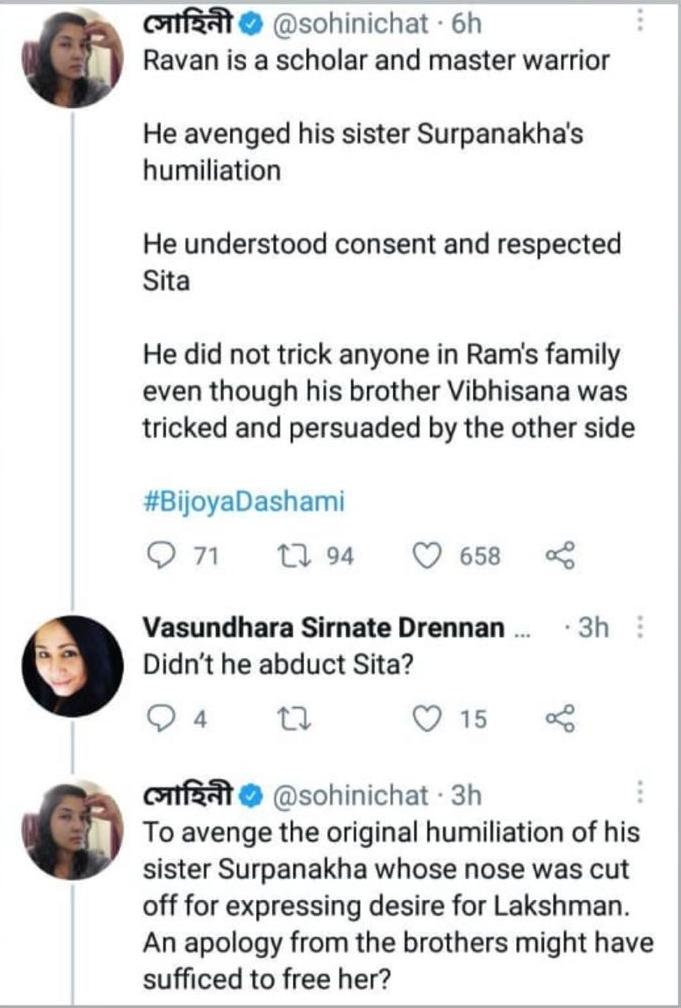
Dussehra (दशहरा), when split, means defeating the 10 bad qualities within ourselves. Those ten are Kaama Vasana (Lust), Krodha (Anger), Moha (Attachment), Lobha (Greed), Mada (Pride), Maatsarya (Jealousy), Swartha (Selfishness), Anyaaya (Injustice), Amanavata (Cruelty), and Ahankara (Ego). The tenth day of Ashweeja/Ashvina maasa in shard rutu is celebrated as Vijayadashami and has great importance in all the Yugas. Bhagavan Sri Rama killed Ravanasura in Treta Yuga, the Pandavas revealed themselves to the world, after their agnyatavaasa (living in hiding), by re-claiming their weapons from the Shami/Jammi tree and saving Virata desha from Hastinapur. It is for this reason the Shami tree is sacred to the Hindus and is worshipped throughout. As one can observe, the day carries immense positive energy and jubilant vibes, however, in a rather sad state of affairs, this festive spirit is being muddled by bringing in distorted, maligned, ill-thought, and half-knowledge information. Veneration and glorification of Ravana by saying he was a scholar, a great warrior, and whatnot are not only appalling but also malicious. One Twitter user, who also writes for The Hindu, also went on to say that Ravana was only avenging his sister, Surpanakha’s, humiliation and that if Rama had apologized that would have sufficed. Even after another user pointed out that Ravana had abducted Sita, the former went on to justify it by saying it was only to avenge.
Such is the idiotic sense of discussion this festival has been reduced to. Oblivious to the fact that Ravana had committed numerous sins, including raping Rambha, the Apsara, a narrative always lurks around the festivals targeting either environment, people, or the personalities involved in the festival. A brief account of Ravana’s ghastly sins can be seen here.
After being vexed with so many fallacies surrounding not just festivals but also the culture as a whole, I have come forward to write and discuss few beliefs, facts, and suggestions from whatever little I know. I certainly do not have the entire knowledge of my culture and certainly do not claim ownership of the rituals or festivals, however, I know enough to say that an infamous narrative is false and distorted. With this consciousness, and blessings of Hari, Vayu, and gurugalu I have decided to be the squirrel in the building of Dharma Sethu, contributing in whatsoever minuscule way I can. I wish to keep my first blog as a glimpse and plan to write more elaborately, giving as much information as possible to whatever I decide to share. Hope you all can enjoy, appreciate, and learn.